
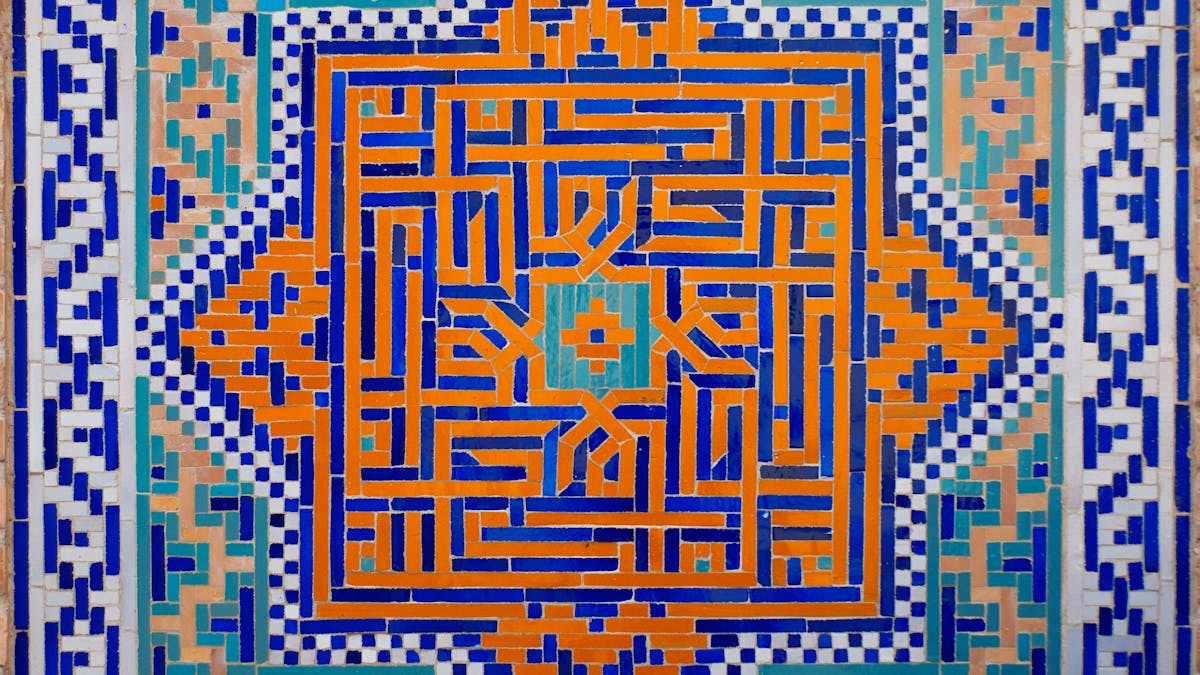
Islamic geometric patterns appear in mosques, tilework, carpets, and manuscripts across the Muslim world. They're not random - they follow strict mathematical rules. Squares, stars, hexagons, and circles interlock in intricate patterns that feel infinite and organic despite being rigorously geometric.
The Principles of Islamic Geometry
Islamic geometric patterns are built on principles developed over centuries:
- Grid foundation: Most patterns start with a square or triangular grid
- Symmetry: Rotational and reflective symmetry are fundamental
- Repetition: A small pattern repeats to fill infinite space
- Mathematical precision: Ratios and proportions follow specific rules
Star Polygons and Tiling
Islamic patterns frequently use star polygons - stars with 6, 8, 10, or 12 points. These stars are mathematically defined: a 6-pointed star is made by overlaying two triangles at 60 degrees offset.
The spaces between stars fill with other geometric shapes (smaller stars, hexagons, squares), creating intricate mosaics. Each shape is defined by mathematical relationships.
Girih Patterns
One important category is girih patterns (from the Persian word for "knot"). Girih tiles are a set of five tiles: a square, hexagon, bowtie, and two 12-sided tiles. These tiles fit together according to specific rules, creating patterns that can be infinitely varied but still maintain mathematical coherence.
In 2007, Peter Lu and Paul Steinhardt published research showing that medieval Islamic architects used girih tile patterns centuries before the mathematical principles were formally described in the West.
Why Islamic Geometry Is Significant
Islamic geometric patterns are significant because they:
- Represent centuries of mathematical knowledge without formal notation
- Are beautiful and functional simultaneously (decoration and mathematics)
- Show that mathematical sophistication existed in the Islamic world centuries before European mathematics caught up
- Demonstrate that art and science are not separate but deeply intertwined
Digital Recreation
Creating Islamic geometric patterns algorithmically requires:
- Define a base grid (square, hexagonal, etc.)
- Create geometric shapes (stars, polygons) at each grid point
- Apply symmetry rules to ensure patterns match at boundaries
- Fill spaces between shapes systematically
Contemporary Applications
Islamic geometric patterns are used in:
- Architectural facades: Modern buildings inspired by traditional patterns
- Textile design: Carpets, clothing, quilts
- Interior design: Tiles, wallpaper, screens
- Digital art: Generative art exploring mathematical symmetry
The Philosophy of Pattern
Islamic geometric patterns embody a philosophical principle: the infinite repetition of finite rules. A single pattern, repeated with symmetry, suggests infinity. This reflects Islamic theology - the infinite nature of God expressed through repeated, finite creation.
Ready to try it? Open GlitchArt Studio and experiment with this effect.